How to jump rope properly: trip less, jump longer
To jump rope properly, hold the handles loosely with your hands near your hip bones, turn the rope from your wrists with your elbows close to your ribs, look straight ahead and hop only 2 to 5 cm on the balls of your feet. Learn it in order: shadow bounce, toe catch, single jumps, then 60 clean seconds.
General information, not medical advice. Stop if you feel dizzy or unwell, and ask a professional about any health concern.
Good rope technique is mostly about doing less. Less height, less arm, less looking down. The rope only needs a few centimetres of space under your feet, and every extra bit of effort costs you rhythm and breath. Here is the setup, the order to learn it in, and the numbers behind each cue.
One line before you start: rope jumping is vigorous and high impact, so if you have not exercised in a while or have a medical condition, get a doctor's view first.
The setup in 30 seconds
Rope length. Stand on the middle of the rope with one foot and pull the handles up. The handle tops should reach about your armpits. The better check happens while you jump: as a beginner, aim for a gap of 30 to 45 cm (12 to 18 inches) above your head at the top of each turn. Our rope length guide and the length calculator go deeper.
Grip. Hold the handles loosely, like a bike handlebar, not a hammer. A tight fist locks the forearm and the wrist stops doing its job.
Hands and elbows. Hands sit near your hip bones, a little in front of the body. Elbows stay close to your ribs. If your hands keep drifting out wide, the rope is probably too long.
Floor. A firm floor with a little give, such as wood, rubber or a jump rope mat. Avoid concrete and carpet: one is hard on the legs, the other grabs the rope.
How to jump rope, step by step
- Shadow bounce, no rope. Hold both handles in one hand or put the rope down. Bounce on the balls of your feet in a steady count of four while your hands turn small circles at your hips. Do 30 to 60 seconds. This builds the rhythm before the rope can punish a mistake.
- Toe catch. Rope behind your calves. Turn it over once and trap it under your toes instead of jumping. This teaches you where the rope lands. Repeat until it lands in the same spot every time.
- One jump, then catch. Turn, jump once, then trap the rope on the next pass. Build a ladder: one jump and catch, two jumps and catch, up to five in a row.
- Single jumps in short sets. Now let it run. Sets of 10 to 20 jumps, a short rest, repeat. Keep each practice window to 5 to 10 minutes. If you trip, reset calmly and start the next set.
- One clean minute. Your first real target is 60 seconds of basic bounce without a miss. Reach it before you add any footwork, because every later skill is built on that rhythm.
The timing cue that fixes most trips
Be at the top of your hop when the rope touches the floor. Not before, not after. Jump too early and you are back on the ground as the rope arrives. Jump too late and it catches your toes.
The window is short. A 2.5 cm hop keeps you in the air for about 0.14 seconds; a 10 cm hop buys about 0.29 seconds. That is simple physics: four times the height for only twice the air time, and far more work for your calves. If timing feels hard, listen. The tick of the rope on the floor is your metronome, and a beaded rope gives you more feel for where it is. When trips persist, our guide on why you keep tripping goes through each cause.
What the lab says about jump height
Coaches have said "jump low" for decades. The biomechanics back them up.
In a 2025 motion-capture study of 12 young elite jumpers, the feet rose about 5% of body height at 100 turns a minute and about 3% at 180 (Zhou and colleagues). For someone 1.70 m tall, that is roughly 8 cm and 5 cm. Knee bend shrank even more, from a range of about 49 degrees at 100 turns a minute to 9 degrees at 180. A much older study (Town and colleagues, 1980) filmed two jumpers and saw the same pattern: as the rope sped up, they jumped lower, which kept their work rate about level.
What this means for you: height is not effort well spent. Good jumpers spend less energy per turn by staying close to the floor with soft, small knee bends. Beginners usually do the opposite, and that is part of why the first minute feels so hard.
Form checklist
- Eyes forward. Looking down folds you at the waist and pulls the rope off line.
- Land on the balls of your feet. Heels barely kiss the floor. Landing flat or on the heels jars the legs and breaks the rhythm.
- Soft knees. A slight bend absorbs each landing. Locked knees turn the hop into a stamp.
- Wrists turn, shoulders relax. If your shoulders burn after a minute, your arms are doing the wrists' job.
- Feet under your hips. Kicking the heels back or pushing the feet forward catches the rope.
- Even hands. If the rope keeps hitting one foot, that hand has drifted wider or lower.
Common mistakes and quick fixes
The double bounce. Many beginners add a small extra hop while the rope is overhead. It is a fine stepping stone, and the 2024 Compendium of Physical Activities rates it as lighter work (8.3 MET against 11.8 for the plain bounce). It caps your speed later, so once you are steady, try eight turns with the extra bounce, then eight without.
Jumping far higher than needed. Count your jumps per minute. If you are working hard and the count is low, you are probably jumping high. Shrink the hop and let the wrists set the pace.
Arms drifting wide. Wide hands shorten the rope. Tuck the elbows back in, or check the length.
Rushing into tricks. Footwork, crosses and doubles all sit on top of the basic bounce. Skip the clean minute and you will relearn it later.
When to move on
Once 60 seconds of basic bounce feels easy, the usual learning order is:
- Basic footwork: the alternate foot step (jogging on the spot), low one-foot hops, then the boxer skip, a weight shift from foot to foot.
- Coordination: the criss-cross, which uses the toe catch you already know.
- Speed: small wrists and lower feet; see how to jump rope faster.
- Double unders: the entry ticket is 100 unbroken single jumps. Our double unders guide has the drills.
The full menu lives in our jump rope tricks guide. No rope yet, or a low ceiling? Start with jumping without a rope and keep the rhythm work going.
Count it, so you know when you are ready
Every threshold in this guide is a count: sets of 10 to 20, five jumps then a catch, 60 clean seconds, 100 unbroken. Counting in your head while you fix your timing is one job too many, and looking down at a watch breaks the eyes-forward rule. You can count jumps by tapping or out loud, or let the phone do it.
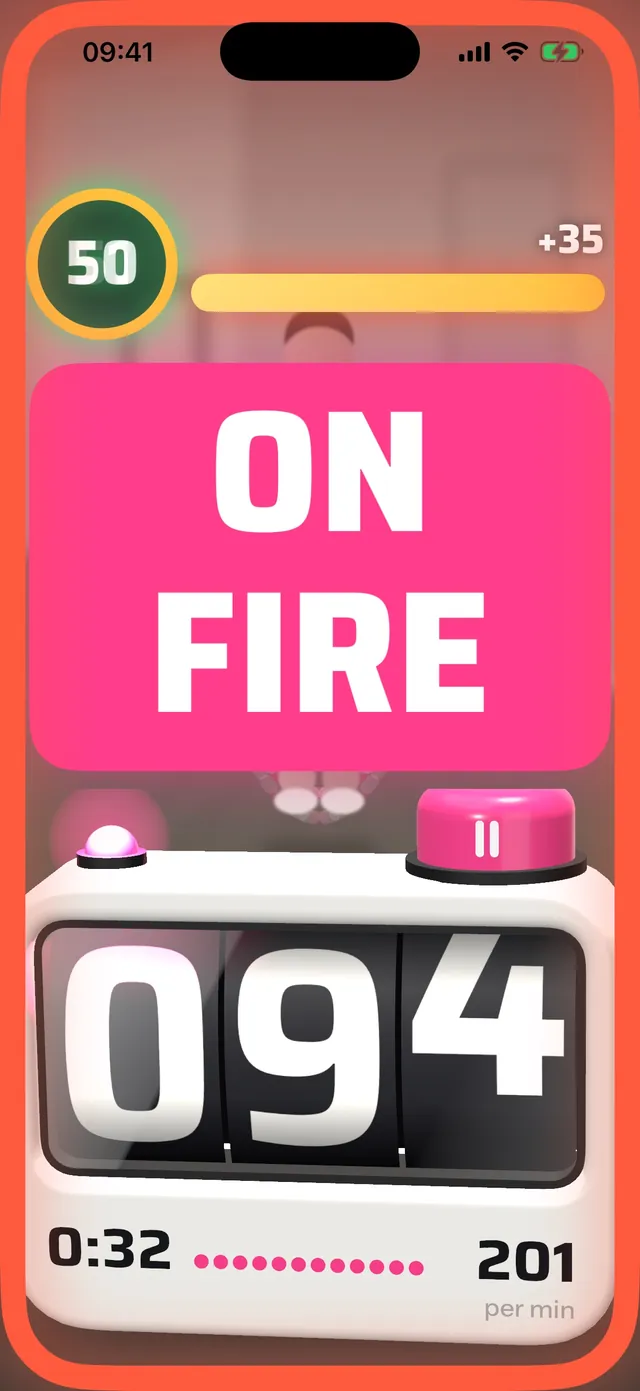
Jump Rope props on the floor, watches you with the front camera and adds each jump as it lands on a counter big enough to read from where you stand. Your run heats up as it grows, from Warm to On fire, and the app keeps your longest run, so the day you pass 60 seconds or 100 in a row is on record. When you want the next skill, its skill sheets show a moving figure, four cues and the usual mistakes. If you are completely new, start with our beginner guide for the first two weeks.
Questions people ask
How high should you jump when jumping rope?
About 2 to 5 cm, just enough for the rope to pass. In a lab study of 12 elite jumpers, the feet rose about 5% of body height at 100 turns a minute and only 3% at 180. Faster rope, smaller hop.
Should you turn the rope with your arms or your wrists?
Your wrists. Keep your elbows close to your ribs and your hands near your hip bones, and draw small circles. Turning from the shoulders tires you fast, and hands that drift wide shorten the rope until it clips your feet.
How long does it take to learn to jump rope?
Most adults get their first run of 10 jumps in the first session and a clean minute of basic bounce within one to three weeks of short practices, three or four times a week. Practise in windows of 5 to 10 minutes and add footwork once that minute feels easy.
Why do I keep tripping on the rope?
Usually timing or hands. Jumping too early lands you before the rope arrives; jumping late lets it catch your toes. Hands drifting out to the side shorten the rope. Aim to be at the top of your hop as the rope touches the floor.
Sources
- Zhou et al. 2025, Bioengineering: biomechanical analysis of cycle-tempo effects among jump rope elites 12 young elite jumpers at 100, 140 and 180 turns/min: foot lift fell from 0.05 to 0.03 of body height and knee range of motion from 49 to 9 degrees.
- Town, Sol and Sinning 1980, Medicine and Science in Sports and Exercise: effect of rope skipping rate on energy expenditure Film of two subjects suggested vertical displacement falls as the skipping rate rises.
- 2024 Adult Compendium of Physical Activities: rope jumping entries Code 15552, slow rhythm (double) bounce, 8.3 MET; code 15551, plain bounce at 100-120 skips/min, 11.8 MET.
Made by EASYTECH, who also make Jump Rope.