How to boxer skip: learn the boxer step in six stages
To jump rope like a boxer, shift your weight onto one foot while the other only taps the floor, two jumps per side, then switch. Learn it after the basic bounce and one-foot hops: hop in sets of 10 per foot, add a light tap, then count down from five jumps per side to one.
General information, not medical advice. Stop if you feel dizzy or unwell, and ask a professional about any health concern.
What the boxer step is
The boxer step is a weight shift, not a hop. One foot carries almost all your weight. The other just taps the floor. Two jumps on one side, then two on the other, while the rope keeps turning. Think of jogging on the spot with the resting foot still touching down.
Boxers use it because it lets them skip for whole rounds. Each leg gets a partial break while the other works, which is why it shows up in every boxing gym warm-up.
Before you start: two gates
Most coaches do not teach the boxer step as a first block. It sits after two skills:
- 60 seconds of clean basic bounce. One low jump per turn, no trip. If you are not there, start with how to jump rope.
- 30 seconds of one-foot hops on each leg. Low hops, the rope still turning.
In the Foundations month of our 30-day workout plans, the boxer step only appears as a taster in the fourth week, after the bounce and the alternate-foot step.
How to boxer skip, in six stages
- Shift without the rope. Stand tall and practise moving about 90% of your weight onto one foot while the other taps a mark on the floor. The support foot lands just before the tap. Switch sides slowly. A boxer would do this in stance as a shadow shuffle.
- Bounce clean. One minute of basic bounce, elbows in, wrists turning, jumps 2 to 5 cm high.
- Hop in sets of 10. Ten low hops on the right foot, then ten on the left, rope turning. Shift your weight fully each time you change feet.
- Add the tap. Hop on one foot and lightly tap the other to the floor on each turn. Say it out loud: hop-tap, hop-tap.
- Count it down: 5, 3, 2, 1. Five jumps on one side, switch. Then three per side, then two, then switch every turn.
- Let it sway. Stop counting. Let the weight rock from foot to foot with the rope. Speed comes last, once the sway runs on its own.
Practise in short windows of 5 to 10 minutes. If you trip, go back one stage instead of forcing the next.
Common mistakes and the fix
| Mistake | What it looks like | Fix |
|---|---|---|
| Lifting the resting foot high | The free foot kicks up and catches the rope | Keep the toes of the free foot brushing the floor |
| Rigid left-right counting | Jerky rhythm, a trip at every switch | Count down 5-3-2-1, then stop counting and sway |
| Adding speed too early | Fast rope, sloppy feet, a trip within 20 jumps | Slow the rope until the shift is automatic |
| Hopping instead of shifting | Big hops on one foot, tired calves | Shrink the jump, move the weight, not the body |
| Freezing on two or three taps | You lose the count mid-pattern and stop | Practise the double tap at half speed first |
| Stiff upper body in the boxer cross | Shoulders lock and the sway stops | Let the forearms and wrists do the crossing |
Boxer step vs basic bounce
| Basic bounce | Boxer step | |
|---|---|---|
| Feet | Together, both land each turn | Both touch, one carries the weight |
| Weight | Even on both feet | About 90% on one foot, switching every two jumps |
| Rhythm | One even beat | A side-to-side sway |
| When to learn it | First | After 60 s of bounce and one-foot hops |
| What it is for | Learning timing, steady cardio | Long rounds, boxing footwork |
| Feels like | Steady, even work | Each leg gets a short break in turn |
One-leg landings carry more force than two-leg ones, but the boxer step keeps both feet touching, so it is not a one-foot hop. The weight rocks from side to side, and each calf gets a few beats of rest every couple of jumps. That is why it lets boxers last through long rounds.
Variations once it flows
- Two and three taps. Stay on one side for two or three jumps before switching.
- Boxer cross. Boxer step underneath, crosses on top. Learn the criss-cross first.
- Fast finish. Push the pace for the last 15 seconds of a round, then ease off.
More skills in learning order live in our jump rope tricks ladder.
Use it in rounds
Boxers skip in rounds, like a fight: about 3 minutes on, 1 minute off, faster in the last seconds of each round. A usual boxing warm-up is 10 to 15 minutes of skipping, and beginners start with 3 minutes total and build up. Our jump rope boxing workout lays out full sessions.
Is rope worth it for boxers? In one controlled study, 24 junior boxers trained for 8 weeks, 30 minutes three times a week. Rope training improved jab speed, punch reaction time and jump force development as much as plyometric training did.
If you keep tripping at the switch, read why you keep tripping. Most fixes are in the timing, not the fitness.
Know when you are really doing it
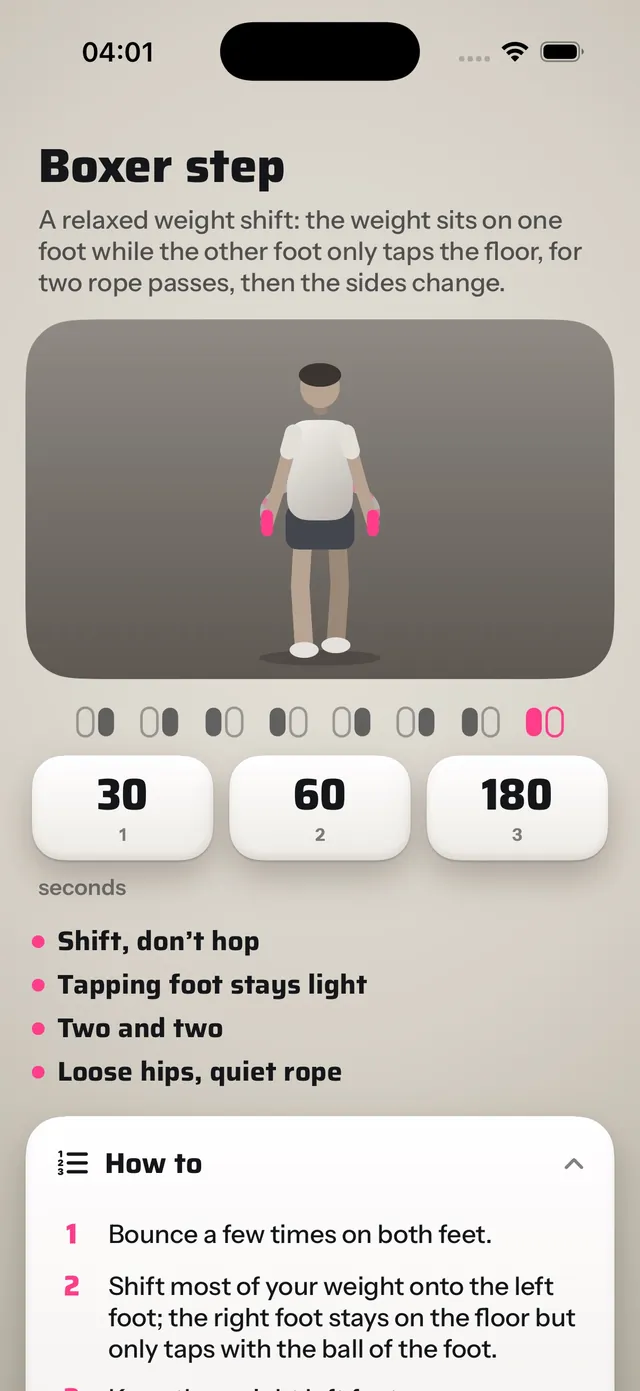
The hard part of learning the boxer step alone is knowing whether you are doing it at all. Jump Rope answers that. Prop the phone up, move back until the frame goes green, then jump: the camera recognises the boxer step while you jump and shows it as one word on screen, next to your live count. Its skill sheet shows a moving figure that keeps the rhythm of the feet, plus four cues, drills, and the common errors with a fix for each. The boxing goal then turns it into 30 days of rounds.
Questions people ask
How do you jump rope like a boxer?
Use the boxer step: one foot carries almost all your weight while the other lightly taps the floor, two jumps per side, then switch, with the rope turning at a steady pace. Keep jumps low and wrists doing the turning. Boxers skip it in rounds of about 3 minutes with a minute of rest.
Is the boxer skip harder than a normal skip?
It takes more coordination, which is why coaches teach it after the basic bounce and one-foot hops. Once it is automatic, most people can jump longer with it, because each leg partly rests in turn.
How long does it take to learn the boxer skip?
It depends on your basic bounce. Coaches ask for 60 seconds of clean bounce and 30 seconds of hops on each leg first. From there, practise in short windows of 5 to 10 minutes and do not add speed until the sway feels automatic.
Why do I trip when I try the boxer step?
Usually the resting foot lifts too high, or you count rigid left-right beats and lose the rhythm. Keep the tapping foot on the floor, shrink the jump, and go back to five jumps per side before trying to switch every turn.
Sources
- Chottidao et al. 2022, Frontiers in Bioengineering and Biotechnology: plyometric vs jump rope training in junior boxers 24 junior boxers, 8 weeks, 30 min three times a week: rope training matched plyometrics for jab speed, punch reaction time and jump force development.
- Yu et al. 2022, Bioengineering: jump-rope footwear and lower-extremity biomechanics 10 people. One-leg landings produced higher ground force than two-leg landings.
Made by EASYTECH, who also make Jump Rope.