Jump rope workout plan: pick the 30 days that fit your goal
A good 30-day jump rope workout plan has 3 or 4 jumping days a week, never more than two in a row, grows about 20-25% a week and retests on day 29. Choose by goal: Foundations for your first month, Rounds for boxing, Skills for double unders and crosses, Steady for more volume at an even pace.
General information, not medical advice. Stop if you feel dizzy or unwell, and ask a professional about any health concern.
Pick by goal, not by hype
Most 30-day jump rope challenges are one plan for everyone. That is why they break people in week two. A boxer, a beginner who trips every 20 jumps and someone chasing double unders need different months.
Below are four 30-day structures. They are built from the doses used in published rope trials and from common coaching practice. Each day in them has a range, rest days are part of the plan, and every structure ends with a retest on day 29.
The four 30-day structures at a glance
| Structure | For | Entry gate | Jumping days a week | Work per session | Weekly jumping time, weeks 1 to 4 |
|---|---|---|---|---|---|
| Foundations | Your first month, general fitness | None | 3 in week 1, then 4 | 1.3 to 10 min, efforts of 30 to 120 s | 8, 20, 26, 35 min |
| Rounds | Boxing-style conditioning | 3 min without stopping and a relaxed boxer step, or Foundations done | 4 | 8 to 18 min, rounds of 2 to 3 min with 1 min rest | 36, 44.5, 54, 63 min |
| Skills | Double unders and the criss-cross | 100 single jumps in a row, or 60 s of clean bounce | 5 short practices | Sessions of 8 to 14 min, dosed in tries | About 13 to 17 min |
| Steady | More volume at an even pace, the weight-goal profile | Foundations done, or 5 x 1 min with 30 s rests and no sore shins next day | 4 | 8 to 15 min, blocks of 2 to 3 min | 32, 40, 48.5, 59 min |
"Work" means minutes of actual jumping. Warm-up, rests and the easy finish come on top, so a Foundations session with 6 minutes of jumping takes about 14 minutes in total.
What a day looks like in each
Foundations. Day 1 is a count ladder. You jump 15, then 25, 35, 25 and 15, resting 30 seconds after each set. Misses are fine, keep going until the set is done. By day 27 you are doing five 2-minute sets with a minute of rest. New footwork, such as the alternate-foot step, only appears after a full minute of bounce without a trip. The boxer step comes as a taster in week 4.
Rounds. Rounds start at 2 minutes with a minute of rest, built on the boxer step. They grow to 3 minutes, and the last 15 seconds of each round go faster, the way boxers skip. See the boxing workout for the full session.
Skills. Three double-under days a week, never back to back, with two cross days between them. Double-under sets are sized from your own best: 50%, then 55%, then 60% of it. Crosses go from one cross with a rope stop to ladders of 2, 4 and 6. Each practice is capped, because beginners chasing a first double under tend to overrun.
Steady. Day 1 is four 2-minute blocks with a minute of rest. Weekly jumping time grows by about a fifth each week, blocks stay at 2 to 3 minutes, and one day near the end uses 5-minute blocks. The pace sits in the moderate band with a two-foot bounce.
How to choose your structure
- Never jumped regularly, or you trip within a minute? Foundations. Everyone starts here, including the weight goal.
- Box, kickbox or want round-based cardio? Rounds, once you can jump 3 minutes and your boxer step is relaxed. Not there yet? Do Foundations first.
- Want your first double unders or clean crosses? Skills, from 100 single jumps in a row.
- Want more weekly minutes, steady and repeatable? Steady, after Foundations.
Not sure where you stand? Time your longest set without a trip. Under a minute points to Foundations.
The rules behind every plan
Each rule is there for a reason.
| Rule | Why |
|---|---|
| 3 or 4 jumping days a week | Rope trials that improved fitness used about three sessions a week; five days from scratch brought more injuries and drop-outs |
| Never more than two jumping days in a row | Calves and Achilles tendons rebuild over a day or two after impact |
| Grow about 20-25% a week | In running studies, weekly jumps above 30% did worse than under 10%, while 24% was no worse than 10% |
| Retest on day 29 | Longest set without a trip, three tries, keep the best: a clear number to beat next month |
| Sore next morning? Repeat the session | Soreness shows up a day or two late, so the morning decides |
| Work and rest splits, round lengths, the order of footwork | Standard rope and boxing coaching practice |
Two more rules sit under the Steady structure. At equal energy, interval and steady training changed weight and fat the same in a review of 149 studies, so Steady uses the gentler option. And higher body mass was a risk factor for shin pain in runners and military recruits, so the weight-goal profile gets more recovery, not less.
On volume: guidelines for vigorous exercise start at about 75 minutes a week, or 500 to 1000 MET-minutes. Steady reaches that MET range in week 3. Foundations stays below it on purpose. Less than the target still counts.
What day 30 gives you
By day 30 most people jump two to three times longer without a trip than on day 1, recover faster between sets, and feel the same session as clearly easier. Keep going: in the best adult rope trial, eight weeks of intervals or steady sessions raised fitness clearly.
So day 30 gives you a base, a habit, and a retest number to beat. For a weight goal, read our weight loss workout guide before you set expectations. To see how long each session should be at your level, see how long you should jump rope. Brand new to the rope? The beginner workout is a gentler first week.
Build your 30 days in a minute
Want the structure laid out day by day for your goal? The 30-day plan builder lays it out. Want it to run itself?
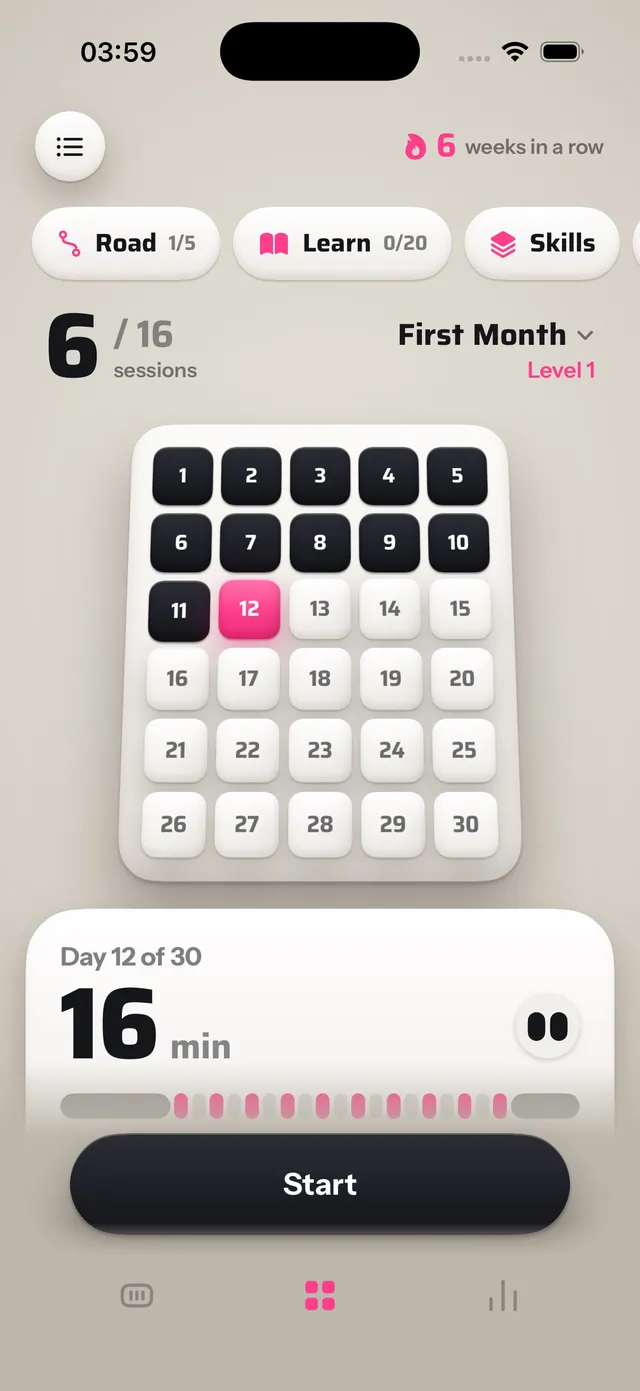
Jump Rope has 21 thirty-day plans across five goals (fitness, weight loss, boxing, tricks and speed) and five levels. Answer a handful of quick questions, do one counted set, and the app places you. From then on the session guides you through itself, from the warm-up and the 3-2-1 to the last easy minute, while the camera counts. Later and Lighter move the plan when life gets in the way. After each one, tap Too easy, Just right or Too hard, and the next session adjusts.
Questions people ask
How many days a week should I jump rope?
Three or four jumping days a week suits most people, with rest days between. Rope trials that improved fitness mostly used three sessions a week. In a trial that put sedentary adults on five days a week straight away, the rope group had more injuries and drop-outs.
What will a 30-day jump rope challenge do for me?
It builds a habit and a base. Most people finish the month jumping two to three times longer without a trip, with a steadier pace, less breathlessness in the same session, and a first boxer step or double under depending on the plan.
Which jump rope plan is best for weight loss?
Start with Foundations, then move to Steady, which grows weekly volume at an even pace with a two-foot bounce. At equal energy, intervals and steady work changed weight the same in reviews. Volume and consistency matter more than the format, and food matters too.
What if I miss a day of my jump rope plan?
Move the session, do not double up. A missed day is a rest day. If your calves or shins are sore the next morning, repeat the last session instead of moving on.
Sources
- Phongchin et al. 2025, European Journal of Clinical Nutrition: interval rope skipping in young adults 59 young adults, 8 weeks: 9 x 2 min intervals three times a week or 30 min steady five times a week both raised fitness; body composition did not change.
- Buyze et al. 1986, The Physician and Sportsmedicine: rope skipping vs jogging 26 sedentary adults on five days a week: the rope group had more injuries and drop-outs.
- Damsted et al. 2018, International Journal of Sports Physical Therapy: training load changes and running injuries Weekly increases above 30% looked worse than under 10%, and 24% was no worse than 10%.
- Garber et al. 2011, ACSM position stand on exercise quantity and quality Vigorous exercise 20 min or more on 3 or more days a week, or 500-1000 MET-minutes a week; gradual progression reduces risk.
- Bellicha et al. 2021, Obesity Reviews: exercise training and weight in adults 12 reviews, 149 studies. Interval and steady training gave the same weight and fat change at equal energy.
- Hamstra-Wright et al. 2015, British Journal of Sports Medicine: shin pain risk factors Higher BMI was a risk factor for shin pain in runners and military personnel.
Made by EASYTECH, who also make Jump Rope.