Jump rope for beginners: week one feels easy, then the calves complain
Jump rope for beginners works best in short doses: 5 to 10 minute sessions, three days in week one, about a minute more at a time, rest days between. Soreness shows up hours later, so if your calves or shins ache the next morning, repeat the last session instead of moving on.
General information, not medical advice. Stop if you feel dizzy or unwell, and ask a professional about any health concern.
Here is how the first week usually goes. Day one feels easy. You get a few sets in, you are out of breath but nothing hurts, and you think you could have done twice as much. Then you wake up two days later and your calves feel like wood.
That gap is the whole story of starting rope. Your heart and lungs tell you how hard a session was right away. Your calves, shins and Achilles tendons report back hours later, often the next morning. So the plan below is built around that delay: start shorter than feels necessary, and let the next morning decide the next step.
What you need before day one
A rope. Start with a beaded or PVC rope. It has enough weight to feel where it is, which means fewer misses. Leave thin speed cables and heavy weighted ropes for later. Our best jump rope for beginners guide compares the types.
The right length. Stand on the middle with one foot and lift the handles: they should reach about your armpits. Mid-jump, look for 30 to 45 cm (12 to 18 in) of space between the rope and the top of your head. A little long is better than short when you are learning. See how long a jump rope should be.
A floor with some give. Wood or a rubber gym floor is ideal. On concrete, lay down a jump rope mat. Avoid carpet, which grabs the rope, and uneven grass.
Cushioned trainers. Every landing goes through the front of your foot. Running and jumping shoes spread foot pressure better than flat, thin-soled shoes.
Space. Clear room in front, behind and above you. Swing the rope once slowly to check the ceiling.
Pregnant, inactive for a long time, or living with a heart, joint or metabolic condition? Get your doctor's go-ahead before day one.
The four rules coaches use for week one
- Keep sessions to 5 to 10 minutes. That includes rests. Actual jumping time is only a few minutes.
- Add about a minute at a time. Only when the previous session left your legs fresh the next day.
- Take rest days. Three jumping days in week one, with rest days between. Rest days are part of the plan, not a break from it.
- Sore next morning? Repeat, do not advance. If your calves or shins ache when you wake up, repeat the last session or take another rest day.
Why so careful? A 1986 trial (Buyze and colleagues) put 26 sedentary adults on rope, jogging or nothing, five days a week for six weeks. The rope group jumped just 10 minutes a session. They still had more injuries and more drop-outs than the joggers. Daily rope for a brand-new jumper is too much, too soon.
Your first two weeks, day by day
This plan follows the first two weeks of a 30-day beginner structure built from trial doses and coaching practice. It uses only the basic bounce, with one taste of footwork at the end. Warm up for 2 to 3 minutes first (shadow bounce, ankle circles, a few slow turns) and finish with 1 to 2 minutes of easy walking.
| Day | Session | Jumping time | Whole session | About how many jumps |
|---|---|---|---|---|
| 1 | Count ladder: sets of 15, 25, 35, 25, 15, 30 s rest | 1.3 min | 6-8 min | 120 |
| 2 | Rest | |||
| 3 | 6 rounds: 30 s on, 60 s off | 3 min | 11-13 min | 210-330 |
| 4 | Rest | |||
| 5 | 8 rounds: 30 s on, 60 s off | 4 min | 14-16 min | 280-440 |
| 6-7 | Rest | |||
| 8 | 8 rounds: 30 s on, 45 s off | 4 min | 12-14 min | 320-460 |
| 9 | Rest | |||
| 10 | 8 rounds: 40 s on, 50 s off | 5.3 min | 14-16 min | 430-610 |
| 11 | 7 rounds: 45 s on, 45 s off | 5.2 min | 13-15 min | 420-600 |
| 12 | Rest | |||
| 13 | 45 s on, 45 s off, plus 20 s tries of the alternate foot step | 5.5 min | 14-16 min | 440-630 |
| 14 | Rest |
Week one adds up to about 8 minutes of actual jumping. Week two is about 20. If you trip during the day-one ladder, keep going until the set is done. If any morning brings sore calves or shins, repeat the previous session before moving on.
Stick to the two-foot bounce in these two weeks. In a lab comparison, it produced lower landing forces than alternating feet, and it is the base for every skill that follows. Our beginner jump rope workout has more sessions at this level.
How to know you are ready for more
You are ready to move past week two when three things are true:
- You can jump 45 seconds without stopping most of the time.
- Your legs feel normal the morning after each session.
- You are close to one clean minute of basic bounce, the milestone before new footwork.
If your timing still falls apart, go back to the step-by-step technique guide or read why you keep tripping. Wondering about frequency later on? See can you jump rope every day and how long you should jump rope.
The beginner mistakes that end week two early
- Doing day five on day one. The session felt easy, so you doubled it. The bill arrives the next morning, or the one after.
- Jumping on concrete with flat shoes. Hundreds of landings a session go through the forefoot.
- Treating the next-morning ache as a dare. It is a signal to repeat, not to push.
- Starting with footwork. The boxer step and high knees come after the basic bounce, not instead of it.
- Counting session time as jumping time. A 15-minute session in week one holds about 4 minutes of rope.
Let the plan carry the counting
The hard part of week one is restraint, not effort. Doing less than you could, logging it, and listening to your legs the next morning.
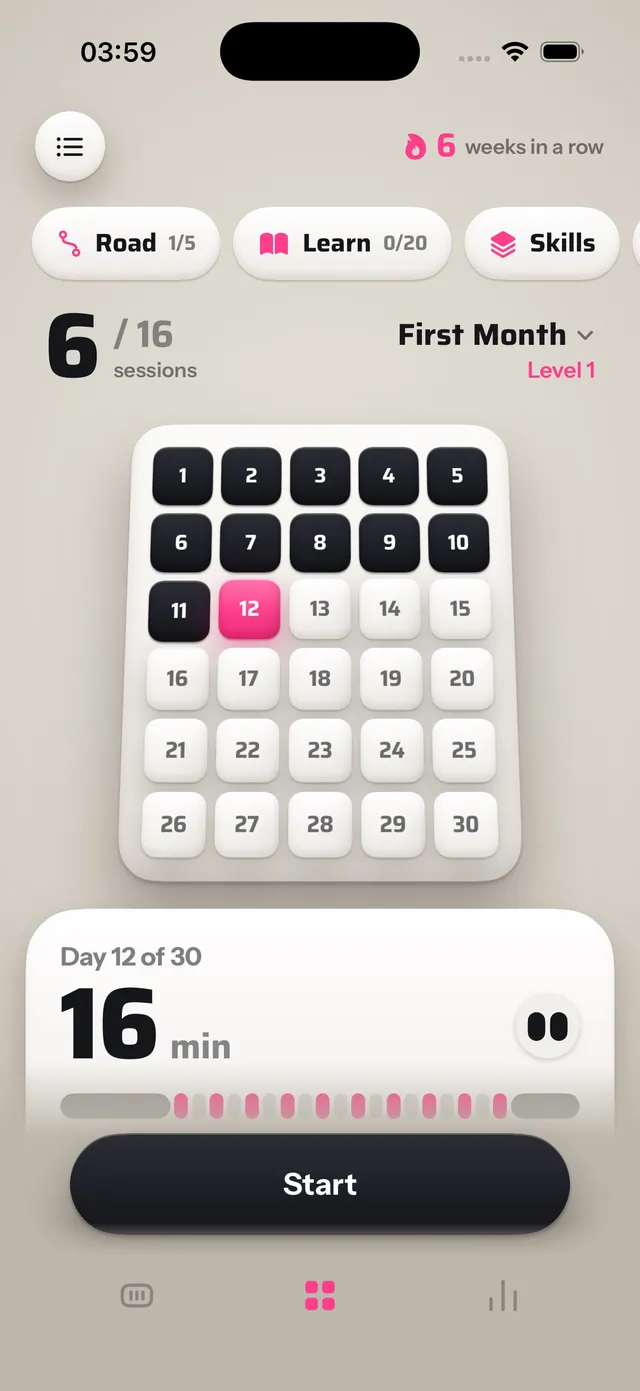
Jump Rope sets this up for you. Answer a handful of quick questions, do one count, and it picks your level. Then a 30-day plan for your goal shows today's session and walks you through it, from the warm-up to the easy finish. Legs heavy? Tap Later or Lighter and the plan shifts. Rate each session (Too easy, Just right, Too hard) and the following one adjusts. The streak counts weeks, so a rest day never breaks it. If you prefer a printable route, our 30-day plan tool lays out a month too.
Questions people ask
How long should a beginner jump rope?
Keep to 5 to 10 minutes a session in the first week, counting rests, with only a few minutes of actual jumping. Add about a minute at a time when the last session left your legs fresh the next morning.
Can a beginner jump rope every day?
Not in week one. When sedentary beginners went straight to five rope days a week in a trial, they had more injuries and drop-outs than a jogging group. Three days with rest days between is the better start.
What rope should a beginner buy?
A beaded or PVC rope with some weight to it, so you can feel where it is. Skip thin speed cables and heavy weighted ropes for now. Size it so the handles reach about your armpits when you stand on the middle.
Is it normal for calves to hurt after jumping rope?
Calves and shins take most of the load, so a dull ache the next day is common in the first weeks. Repeat the last session or rest another day. Sharp pain, or pain that builds while you jump, is different: stop and get it checked.
Sources
- Buyze et al. 1986, The Physician and Sportsmedicine: comparative training responses to rope skipping and jogging 26 sedentary adults, five sessions a week for six weeks: the rope group (10 min) had higher injury and drop-out rates than the jogging group (30 min).
- Lin et al. 2022, Children: rope jumping methods and lower-limb biomechanics in adolescents The two-foot bounce showed lower ground reaction force and loading rate than alternate-foot jumping in a lab test.
- Yu et al. 2023, IJERPH: footwear selection, plantar pressure and muscle activity in jump rope training Running and jumping shoes performed better than the comparison shoe.
Made by EASYTECH, who also make Jump Rope.