Jump rope HIIT workout: three interval sessions of about 15 minutes
A jump rope HIIT workout alternates hard sets with short rests. In an 8-week trial, nine 2-minute rope intervals three times a week raised fitness as much as 30 steady minutes five times a week. Start at 30 seconds on and 60 off, build toward 90 on and 30 off, and end each set before your form breaks.
General information, not medical advice. Stop if you feel dizzy or unwell, and ask a professional about any health concern.
Intervals or steady: what the studies say
Short on time? Intervals give you the most fitness per minute on a rope, and the evidence backs it.
- The rope trial. In Phongchin 2025, 59 young adults trained for 8 weeks. One group did nine 2-minute sets at 80% of max heart rate with a minute of easy recovery, three times a week. The other jumped 30 steady minutes at 70%, five times a week. Both raised their oxygen uptake by about the same amount (from 43.8 to 48.4, and from 42.2 to 47.2 ml/kg/min). Enjoyment was the same. Body composition did not change in either group.
- The bigger picture. Across 28 controlled trials in 723 healthy adults (Milanovic 2015), interval training raised oxygen uptake by 5.5 ml/kg/min against no exercise, and endurance training by 4.9. Both large, intervals slightly ahead.
- For a weight goal. A review of 149 studies (Bellicha 2021) found no difference in weight or fat change between interval and steady training when the energy spent was the same.
So the verdict: intervals save time and suit people who like effort in bursts. Steady suits people who like a rhythm. Both build fitness. The one you repeat for months wins.
Before you start: a base and a rule
Intervals are for people who can already keep the rope going. If you trip every 15 jumps, you will spend your hard sets untangling. Get to about a minute of clean basic bounce first with the beginner workout.
The rule for every session below: rest before you fail. End a set at your first sloppy trip, not your fifth. Tired jumping means high jumps, wide arms and heavy landings, and that is the part that hurts the calves. Stretch the sets a little each week instead.
Warm up for 2 to 3 minutes before each session: shadow bounce, ankle circles, a few slow turns. Finish with a minute or two of easy walking.
Session A: the ladder, from 30/60 to 90/30
The workhorse. A good 30-day ladder opens with 30 seconds on and 60 off and reaches 90 on and 30 off by week 4. Climb it one step at a time.
| Step | Work | Rest | Rounds | Jumping time | Total with warm-up |
|---|---|---|---|---|---|
| 1 | 30 s | 60 s | 8 | 4 min | About 15 min |
| 2 | 45 s | 45 s | 8 | 6 min | About 15 min |
| 3 | 60 s | 45 s | 7 | 7 min | About 15 min |
| 4 | 75 s | 45 s | 6 | 7.5 min | About 15 min |
| 5 | 90 s | 30 s | 6 | 9 min | About 15 min |
Move up one step when your calves feel fresh the morning after. Stay on a step, or go back one, if they are sore. Use the basic bounce for every set at first. Once that feels easy, switch to the alternate-foot step for the second half of each set.
Session B: the trial format, 2-minute sets
This is the shape that matched five steady sessions a week in the trial: 2 minutes hard, 1 minute of easy recovery (march or shadow bounce on the spot).
- Short version, about 15 minutes: warm-up, then 4 sets of 2 minutes on, 1 minute easy. 8 minutes of jumping.
- Full trial dose, about 30 minutes: 9 sets of 2 minutes on, 1 minute easy. 18 minutes of jumping.
Hard means about 80% of your max heart rate in the trial. Without a monitor, aim for a pace you could hold for the 2 minutes but not for 3, breathing hard, still able to say a few words. Work toward the full dose over weeks, not in one go.
Session C: a 20/10 block (Tabata timing)
Twenty seconds as fast as you can turn cleanly, ten seconds of rest, eight times. That is 4 minutes. The format is named after a 1996 study on an exercise bike, and the timing transfers neatly to a rope. It fits well in the third week of an interval month.
A 15-minute session:
- Warm-up, 3 minutes.
- Block 1: 20 s on, 10 s off, 8 rounds, basic bounce.
- Easy walk, 2 minutes.
- Block 2: 20 s on, 10 s off, 8 rounds, alternate-foot step or high knees.
- Easy finish, 2 minutes.
Keep this one for when Session A step 3 feels comfortable.
How to make a rope interval harder
Rope speed has a ceiling, and it sits in your hands. In 23 rope skippers, turning speed tracked overall speed far better than jumping did. So when you push, push with small, fast wrists and keep the jump low. Other ways to raise the effort:
- Longer sets before shorter rests.
- Alternate-foot or speed step instead of the two-foot bounce.
- High knees for the last 10 seconds of a set.
Change one thing per week. Add time or add pace, rarely both.
How often
Two or three interval days a week, never back to back. The trial group trained three times a week. A 1986 trial that put sedentary adults on five rope days a week saw more injuries and drop-outs, which is why rest days stay in. If you want rope on other days, keep those easy and short. More session ideas live in our jump rope workouts hub and the 10-minute workout.
See your intervals, set by set
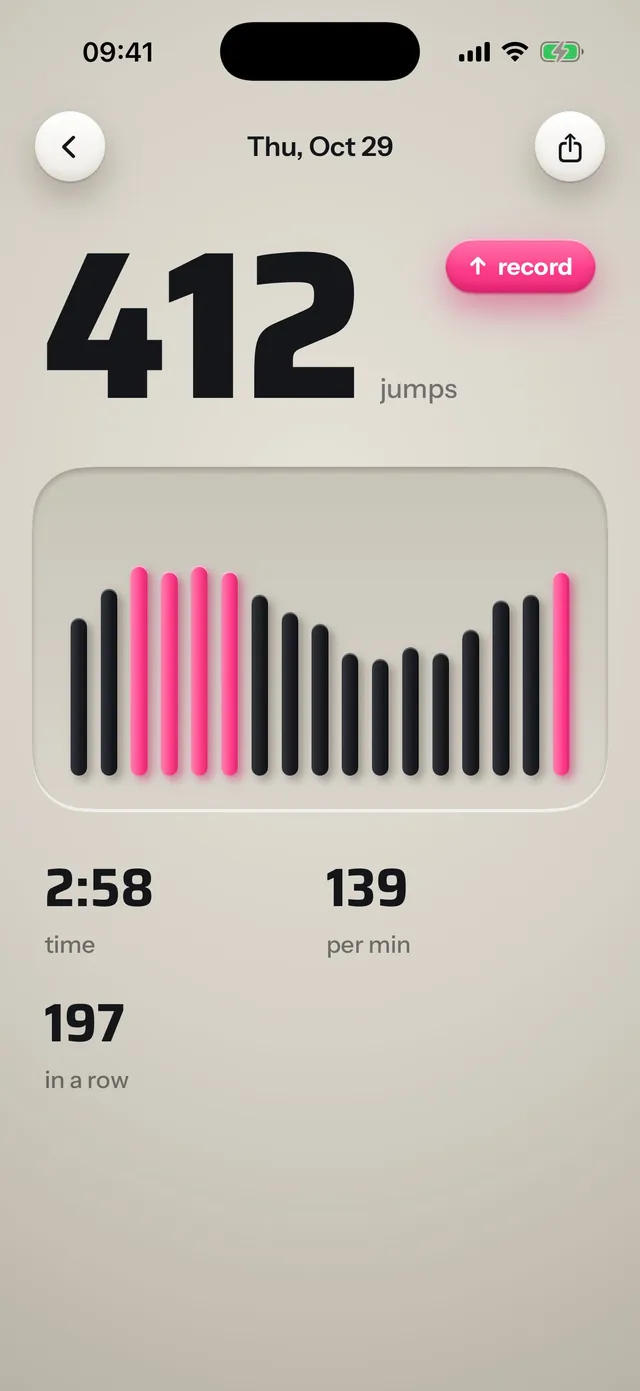
Intervals live or die on the last sets. Jump Rope counts every jump with the camera and draws your pace for the whole session and sets your top speed, average pace, longest run and steadiness next to your usual numbers. You see exactly which round faded. With Jump Rope Pro, the interval builder lets you set your own rounds, work and rest.
Questions people ask
Is jump rope HIIT better than steady jumping?
For fitness, both work. In one rope trial, intervals three times a week matched steady sessions five times a week. Across 28 trials, intervals edged ahead slightly. For weight, reviews found no difference at equal energy. Pick the format you will repeat.
How long should a jump rope HIIT workout be?
About 15 minutes with warm-up is plenty for most people, with 4 to 12 minutes of actual jumping. The trial format used 18 minutes of work, nine 2-minute sets, but that came after a base. Start smaller and grow by about a minute per session.
Is Tabata good for jump rope?
Yes. The 20 seconds on, 10 seconds off timing works well on a rope: eight rounds is a 4-minute block that leaves you breathing hard. Turn the rope as fast as you can while staying clean, and keep it for when you have a base.
How many times a week should I do jump rope HIIT?
Two or three times a week, on days that are not back to back. The interval group in the trial trained three times a week. Fill the other days with rest or easy movement, since your calves need time between hard rope sessions.
Sources
- Phongchin et al. 2025, European Journal of Clinical Nutrition: interval rope skipping in young adults 59 young adults, 8 weeks. 9 x 2 min at 80% of max heart rate with 1 min active recovery, three times a week, vs 30 min at 70% five times a week. Oxygen uptake rose from 43.8 to 48.4 and from 42.2 to 47.2 ml/kg/min; body composition unchanged; enjoyment similar.
- Milanovic et al. 2015, Sports Medicine: interval vs endurance training for VO2max 28 controlled trials, 723 healthy adults aged 18 to 45. Against no exercise: +5.5 ml/kg/min with intervals, +4.9 with endurance training.
- Bellicha et al. 2021, Obesity Reviews: exercise training and weight in adults No difference in weight or fat loss between aerobic and interval training when energy spent was equal.
- Tabata et al. 1996, Medicine and Science in Sports and Exercise: high-intensity intermittent training Cycle ergometer, seven subjects: seven to eight 20 s efforts at about 170% of VO2max with 10 s rest, five days a week for six weeks.
- Lorke et al. 2022, Journal of Motor Behavior: speed rope skipping 23 rope skippers. Turning speed, not jumping, tracked overall skipping speed.
- Buyze et al. 1986, The Physician and Sportsmedicine: rope skipping vs jogging Sedentary adults on five rope days a week had more injuries and drop-outs than joggers.
Made by EASYTECH, who also make Jump Rope.